Abilities may just be one of the most important aspects of a Dungeons & Dragons character. They affect whether your attacks hit, the power of spells, and how successful you are at using skills. In this first post in our D&D Breakdown for Beginners, we will explain each ability, how they affect your character, and how you actually use these in gameplay. The goal is to give new players (or those who want a deeper understanding) a simple explanation so they can play confidently.
Jump to:
- Understanding Each Ability
- Ability Modifiers
- What are Skills?
- Roleplaying Your Abilities
- Owlbear Opinion
Introduction to Abilities
Abilities (sometimes called stats) define a character’s physical or mental attributes. D&D breaks these attributes into 6 categories: Strength, Dexterity, Constitution, Intelligence, Wisdom, and Charisma. When you build a character, you will choose how you wish to assign points into these categories. How your points are assigned will determine what your character is good at and where they might struggle. An Ability Score of 10 means you are average in that category. A higher score will make it easier to use that ability while a lower score makes it harder. This is covered more in the section on Ability Modifiers.
If one stat is important to you, you will probably want to make sure it is high at the beginning. You will have limited opportunities to increase these scores later in the game as you gain levels or acquire items.
Understanding Each Ability
So what do each of these abilities do for you and how do they affect your character? Let’s go into more detail for each.
Strength
Strength is probably the most straightforward. It is a measure of your capacity for brute force. Need to knock down a door? Want to blow enemies away with a swing of your mighty axe? This is the ability for you. Characters with high Strength hit harder, can carry more, and are harder to knock down.
- Notable Features:
- Strength Ability Modifier is added to attack rolls and damage for melee and thrown weapons;
- Minimum Strength score required to wear heavy armor;
- (2024 Rules) Minimum Strength score required to use heavy weapons without being at disadvantage
- Associated Skills: Athletics
- Examples of Characters with High Strength: Batman, Hercules, Xena: Warrior Princess
Dexterity
Dexterity reflects your fine motor skills and coordination. Would you describe your character as agile, graceful, or quick? Characters with high Dexterity are better at sneaking, acrobatics, and precision attacks. Characters wearing light or medium armor have more freedom of movement than those wearing heavy armor. Because of this, they can add their Dexterity modifier to their Armor Class. The higher the Armor Class, the harder it is to hit you. Your Dexterity modifier is also added to your Initiative. This shows how quickly your character reacts to a situation as it unfolds. Initiative sets turn order when you enter combat.
- Notable Features:
- Dexterity Ability Modifier is added to attack rolls and damage for ranged weapons. It can also be added to finesse weapons (ex: daggers, rapiers) instead of Strength
- Modifier is added to Armor Class for light and medium armor (medium capped at +2)
- Dexterity modifier is added to Initiative rolls
- Associated Skills: Acrobatics, Sleight of Hand, and Stealth
- Examples of Characters with High Dexterity: John Wick, Harley Quinn, Legolas
Constitution
Constitution is basically your life force. It defines how healthy a character is. This affects your hit point total, hit dice (a way to get hit points back during rests), and your ability to resist poison and disease. Characters with a robust constitution can keep trudging farther, avoid being exhausted by weather events, and resist certain conditions. Some spells require the caster to maintain concentration for the effect to keep going. In a fight, a concentrating spellcaster who gets hit will need to make a Constitution save to avoid breaking the spell.
- Notable Features:
- Hit points are directly tied to this score
- Raising Constitution at later levels lets you add a hit point for each level you have gained
- Associated Skills: No official skills; only the skills your DM decides you need to live
Intelligence
The Intelligence score shows your character’s reasoning skills as well as how book smart they are. Is your character a keen investigator with a sharp mind? Have they devoted themselves to the study of a subject? A character with high Intelligence will be good at skills that require memorization, critical thinking, and the gathering or accessing of knowledge. Because they are Intelligence based classes, wizard and artificer spells increase in power along with their Intelligence score.
- Notable Features:
- Intelligence modifier is added to spell attack rolls and spell save DC for wizards and artificers
- Associated Skills: Arcana, History, Investigation, Nature, and Religion
- Examples of Characters with High Intelligence: Sherlock Holmes, Hermione Granger, Gandalf
Wisdom
Wisdom correlates to observation and emotional intelligence. Is your character streetwise or worldly? Do they pick up on the subtle clues that someone may be lying? Can they sift through mud and leaves to find a trail for the hunt? A character with high Wisdom is more observant of the world around them making it easier to notice things or pick up on the intentions of others. Wisdom skills, especially Perception, are probably the most used skills outside of combat. Being able to add a Wisdom bonus to a Medicine check can save a downed character. Spells for clerics, druids, and rangers get stronger as their Wisdom score increases.
- Notable Features:
- Wisdom modifier is added to spell attack rolls and spell save DC for clerics, druids, and rangers
- Associated Skills: Animal Handling, Insight, Medicine, Perception, and Survival
- Examples of Characters with High Wisdom: Uncle Iroh, Dana Scully, Tyrion Lannister
Charisma
Charisma is simply a character’s force of personality. This determines how easily they can get people to do what they want. Charismatic characters can be inspiring leaders, entertaining performers, intimidating tyrants, fast talking swindlers, or romantic charmers. A character with high Charisma comes in handy anytime you need to talk your way into or out of something. Bards, sorcerers, paladins and warlocks use Charisma to cast spells.
- Notable Features:
- Charisma modifier is added to spell attack rolls and spell save DC for bards, sorcerers, paladins, and warlocks
- Associated Skills: Deception, Intimidation, Performance, and Persuasion
- Examples of Characters with High Charisma: Hannibal Lector, Jack Sparrow, Midge Maisel
Ability Modifiers
The Ability Score Modifier (or Ability Modifier) is a number based on your Ability Score that is added to or subtracted from attacks, saves, and skill checks. In fact, this is the score that most people are familiar with in D&D. The Ability Score Modifier is the number that actually gets added to dice rolls. When someone says “I have a +3 to Dexterity,” this is what they mean.
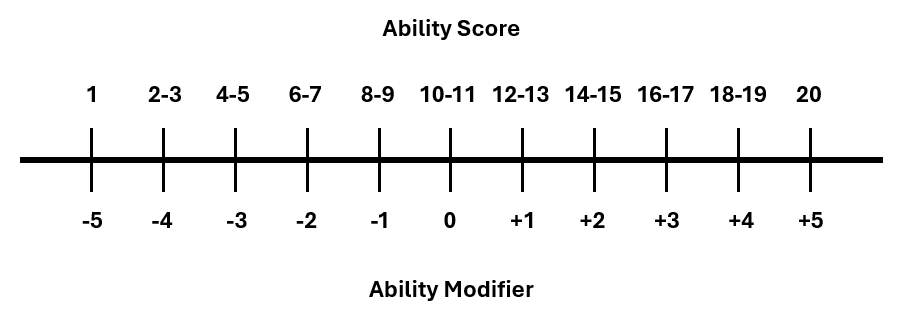
Remember how we said having a score of 10 makes you average? This equates to a +0 Ability Modifier. For every 2 points you move away from 10, the modifier will go up or down by 1.
That means that your modifier goes up to +1 for Ability Scores of 12 to 13, +2 for scores of 14 to 15, +3 for scores of 16 to 17, +4 for scores of 18 to 19, and +5 at 20. If your score is less than 10 in an ability, the modifier goes down to -1 for scores of 8 and 9, -2 for scores of 6 and 7, -3 for scores of 4 and 5, -4 for scores of 2 and 3, and -5 for a score of 1 in an ability.
Using an Ability Score Modifier
Using your Ability Score Modifier makes you do a little math. For example, the DM asks you to make a Dexterity check. You roll a D20 dice and add your modifier. Let’s say you roll a 12 and add your Dexterity modifier +3. The DM will let you know if your total 15 is high enough to succeed the check. Combat uses this same method of roll dice, add modifiers, evaluate score to determine if the attack succeeds.
There are other bonuses that can be added along with the Ability Modifier such as Proficiency if your race (2014 rules)/species (2024 rules), class, or background grant it. This will be covered in more depth in another post.
What are Skills?
Abilities manifest as skills. To be better at a skill, you need to build the associated Ability Score. When you decide to take an action that has a risk of failure, the DM will ask you to make an ability or skill check based on the action you have chosen. If you want to look for clues, you might be asked to roll for Investigation (Intelligence) or Perception (Wisdom). If you want to climb a set of broken stairs, they may ask you to roll for Athletics (Strength) or Acrobatics (Dexterity).
Just because you don’t have a high modifier in a skill does not mean you shouldn’t try it. Rolling for skills adds an element of unpredictability into roleplaying games. Sometimes having a high Ability Modifier isn’t going to be enough to make up for a bad roll. Other times, the character you least expect will roll well and pull off something spectacular. Even if there isn’t a high chance of success, give it a shot. Some DM’s might allow a success even for failed dice rolls if the results will be epic enough.
Roleplaying Your Abilities
The great thing about games like Dungeons & Dragons is that you are free to roleplay your character’s traits as you like. What a character (or person) is good or bad at does not define who they are. Think about what the character wants out of the adventure. How do their abilities help or get in the way of achieving their goal? Factor this in as you make your character’s choices. In the example below, we are going to sketch out ideas for two characters that play into their strengths and weaknesses based on their scores.
For this example, we are making 2 jugglers: a high Charisma/ low Dexterity bard and a High Dexterity/ low Charisma rogue.
Example #1 The Butterfingered Bard
Our bard juggler has high Charisma but low Dexterity. The bard has built their career on being funny rather than actually good at juggling.
The DM may ask for a Performance skill check to test if they successfully entertain a crowd but also a Dexterity check to see if they actually juggle during the performance. What happens if they roll well for performance but bad for dexterity? Maybe the audience bursts into laughter. Roll high enough and they toss some coins too! Actually succeeding the Dexterity check can be a cause for celebration. Our bard may let it go to their head and spend the rest of the session bragging about their exploits. Because of the randomness of the dice rolls, you never know if the joke will land with the crowd or if against all odds they pull off the juggling act.
Example #2 The Awkward Rogue
Our juggling rogue has high Dexterity but low Charisma. They were raised in the circus but now use their skills juggling daggers as a mercenary. Their thrown weapon attacks would use the Dexterity modifier.
However, if our rogue tried to juggle in the street as a distraction for the party, the DM would have to ask for a Performance check. What happens if they roll badly? Does the crowd ignore them leaving the party exposed? A low enough roll could end with a townsperson being offended and starting a fight. Does the party leave the rogue to fight by themselves while people are distracted or give up the plan to help? What happens if they roll well? Maybe the rogue discovers a love for the spotlight and tries to get back to their circus roots by wearing flashy clothing or telling jokes.
Abilities are a road map for roleplaying. Embracing the good and the bad can lead to opportunities you haven’t imagined yet.
Owlbear Opinion
Here at the Owlbear Lair, we always recommend building your character as a whole person. They are a combination of their abilities- good and bad. Some websites recommend maxing out one ability while sacrificing others. This can be a legitimate strategy, just not one we prefer. Most games start characters at low levels. Think of where your character came from and how they came to be here now. We like to base stats on that. It leaves your character room to grow as they gain experience on their adventure.